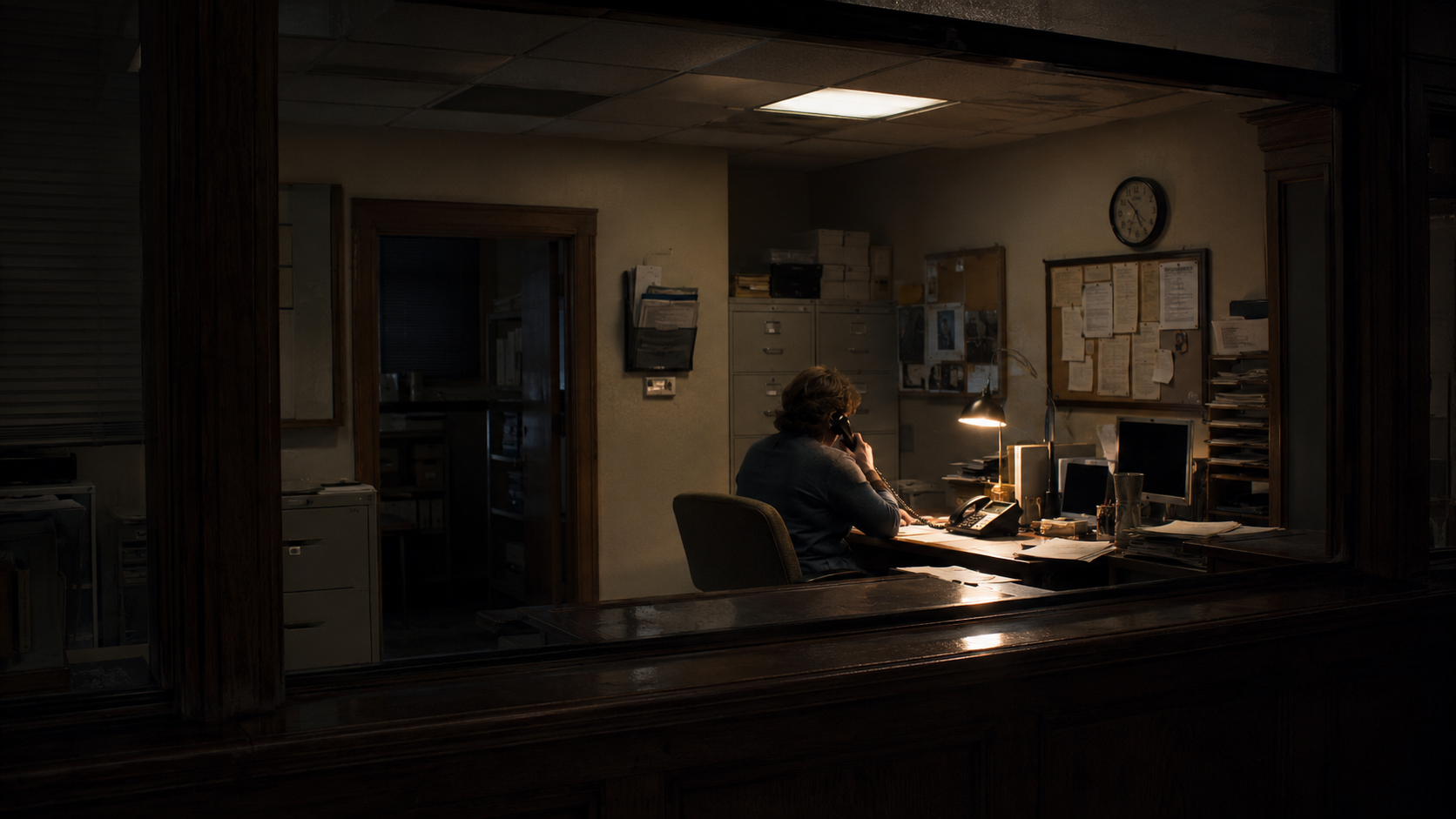
Someone is Still Answering the Phone
A few years ago, when I worked in the Cook County Secretary to the Board’s Office, I sat near the front of the office.
I liked that spot.
I could see the main door when people came in. My desk phone had my direct line, but it was also connected to the office’s main number. So when people called the office, there was a decent chance I was the one who picked up.
I liked picking up the phone.
That may sound small, but it mattered to me. I liked representing the office. I liked being one of the voices of the place.
A small thing. But not nothing.
The Secretary to the Board’s Office was one of those strange offices in government that people sometimes reached by accident. They were looking for the Board President, a commissioner, “the county,” or just someone who might know where to send them.
Sometimes they had the wrong office.
Sometimes the wrong office was the best place they could have landed.
One day, I picked up a call from Tennessee.
It was a grandmother.
She did not know exactly who she had called. She did not need the Secretary to the Board. She did not need the County Board. She probably did not know what our office did at all.
She needed a birth certificate.
Her grandson’s father had recently died. His mother, the grandmother’s daughter, had died years earlier. Both parents, she told me, had struggled with addiction at different points.
Now the boy was turning sixteen.
He was bright, she said. He wanted to go to college. He wanted to take the SAT.
But he had no birth certificate.
And because he had no birth certificate, he could not get a photo ID. Because he could not get a photo ID, he could not get a learner’s permit. And because he did not have a valid ID, he could not sit for the SAT.
A missing record had become a wall.
She knew he had been born in Chicago, or somewhere near Chicago. But she did not know how to prove it. So she did what most people do now when they are desperate and far away from the institution they need.
She went online.
She searched for something like “Cook County birth certificate.”
The internet gave her options.
One of them looked official enough.
She paid.
Then she learned that what she had paid for was not necessarily the record itself. It was a third-party service that would attempt to find a record. Somewhere in the fine print, in language ordinary people are not meant to notice, it said there was no guarantee.
Maybe it was a scam. Maybe it was not technically a scam. Maybe it was one of those things that survives by being just official-looking enough to exist and just unclear enough to hurt people who are already confused.
Either way, she was out money she did not have.
But she kept going.
She searched again. She found another site that seemed more legitimate, maybe more directly connected to Cook County. She paid again. She called. She waited. She followed the channels she was told to follow.
Still, no birth certificate came.
And then, by some combination of Google, switchboards, and grace, she ended up on the phone with me.
At the time, the vital records operation was under enormous strain. That is not a criticism of the people who worked there. It is almost the opposite.
It is what happens when a public office has too much work, too few people, old systems, modernization projects, hiring delays, training constraints, backlogs, and real human demand pressing on it every day.
From the outside, people often talk about “the government” as if it is one thing.
From the inside, you learn it is not one thing.
It is people, offices, phone lines, forms, inboxes, records, rules, software, budgets, elected officials, clerks, administrators, managers, lawyers, frontline staff, and citizens who just need someone to help them solve the thing in front of them.
And sometimes all of that comes down to one grandmother in Tennessee trying to help her grandson take the SAT.
She had done what she was supposed to do.
She had searched. She had paid. She had called. She had waited. She had tried again. She had accepted that she might have been taken advantage of and still kept going.
By the time she reached me, she was not angry in the way people sometimes are when they call government offices.
She was tired.
She was worried.
She was humble.
She was trying to do right by a child who had already lost too much.
So I told her I would help.
We talked for maybe fifteen or twenty minutes. I asked her to send me everything she had. Not a polished email. Not a perfect explanation. Just everything.
Letters from the school. Names. Dates. Prior emails. Receipts. Anything that showed what she had tried to do and why this mattered.
I told her not to worry about making it pretty.
Just send it.
Then I took what she sent and brought it to the people who could actually help.
And they did.
That is the part people miss.
A birth certificate is not just a document.
It is access.
It is identity.
It is school.
It is work.
It is a driver’s license.
It is proof that you exist in the eyes of the systems that govern modern life.
When that proof is missing, everything else becomes harder.
That boy did not need a theory of government.
He needed a record.
His grandmother did not need a lecture about the correct department.
She needed a person.
I have been thinking about that call again because recently I had a different conversation with a county office while researching opioid settlement funds. I called to ask whether the county was distributing settlement dollars as subgrants to nonprofits or using the funds internally.
The employee put me on hold for a moment.
When she came back, she asked me, very gently:
“Do you need Narcan?”
I was taken aback.
“No,” I said. “But thank you. I appreciate that.”
I had asked a grants management question.
She heard the possibility of an emergency.
That small moment stayed with me for the same reason the grandmother’s call stayed with me.
In both cases, the phone call was not just a transaction. It was a human being listening for the question beneath the question.
That is public service at its best.
A grandmother in Tennessee calling the wrong office in Cook County.
A county employee asking a stranger if he needs Narcan.
A person at a desk deciding that the call in front of them is not an interruption from the work, but part of the work.
This is also why I do not think the lesson is simply, “Good people make the difference.”
They do.
But good people are not enough.
The grandmother needed someone to care. But she also needed a functioning records office. She needed trained staff. She needed a system that could search, verify, issue, and communicate. She needed enough capacity that her request did not disappear into a backlog.
Compassion without capacity becomes frustration.
Capacity without compassion becomes bureaucracy.
Public service requires both.
The older I get, the more I think institutions are made real by the small decisions people make inside them.
Pick up the phone.
Listen a little longer.
Find the right person.
Move the email.
Do not let this one disappear.
Sometimes the person who answers the wrong phone becomes the institution.
Not the whole institution.
Not the law.
Not the budget.
Not the official process.
But for the person calling, in that moment, the institution becomes as real as the voice on the other end of the line.
That is not an argument against modernization. It is a reminder of what modernization is for.
The point of better systems is not to eliminate the human being. It is to make sure the human being has a fighting chance to help.
The point is making sure a real human need does not get lost.
Because somewhere there is still a grandmother trying to get a document for a boy who wants to go to college.
Somewhere there is still a person calling a county office who may or may not know how to ask for what they actually need.
Somewhere there is still a public employee answering a phone and deciding, in a small and quiet way, what kind of institution they represent.
Public service still happens in those moments.
Not only in hearings.
Not only in budgets.
Not only in programs.
Not only in strategy documents or modernization plans.
Sometimes it happens when the wrong person calls the wrong number, and the person who answers decides to help anyway.